The Summit
Uhuru Peak Kilimanjaro: Summit Guide at 5,895m
5,895 meters of volcanic crater rim, ancient glaciers, and thin air. What reaching the roof of Africa actually feels like — and how to get there successfully.

Uhuru Peak is not a place you pass through. It is the destination that every step of a Kilimanjaro climb builds toward — from the rainforest at the base to the glacier fields at 5,895 meters. This guide covers what the summit actually is, what you will see and feel when you arrive, and how 48 years of local experience changes the odds in your favour.
What Is Uhuru Peak?
Uhuru Peak (5,895m / 19,341 ft) is the highest point on Mount Kilimanjaro and the highest point in Africa. It sits at the northern crater rim of Kibo, the highest and most dormant of Kilimanjaro's three volcanic cones (Kibo, Mawenzi, and Shira). The summit is a broad snowfield — not a pointed mountain peak — which makes the final approach feel almost anti-climactic until you see the sign and realize exactly where you are standing.
Elevation
5,895m
19,341 feet above sea level
Meaning
Uhuru
'Freedom' in Swahili
First Ascent
1889
Hans Meyer & Ludwig Purtscheller
The name "Uhuru Peak" was officially adopted in 1964, replacing the earlier colonial names. It reflects both the mountain's location in an independent African nation and the universal significance of reaching the summit — freedom in the sense of having achieved something that demands everything you have.
The Geography of the Summit Zone
Understanding what the summit zone actually looks like changes how you prepare for it. It is not a mountain peak in the conventional sense — it is the eroded rim of a volcanic crater, covered in snow and ice that is in active retreat.
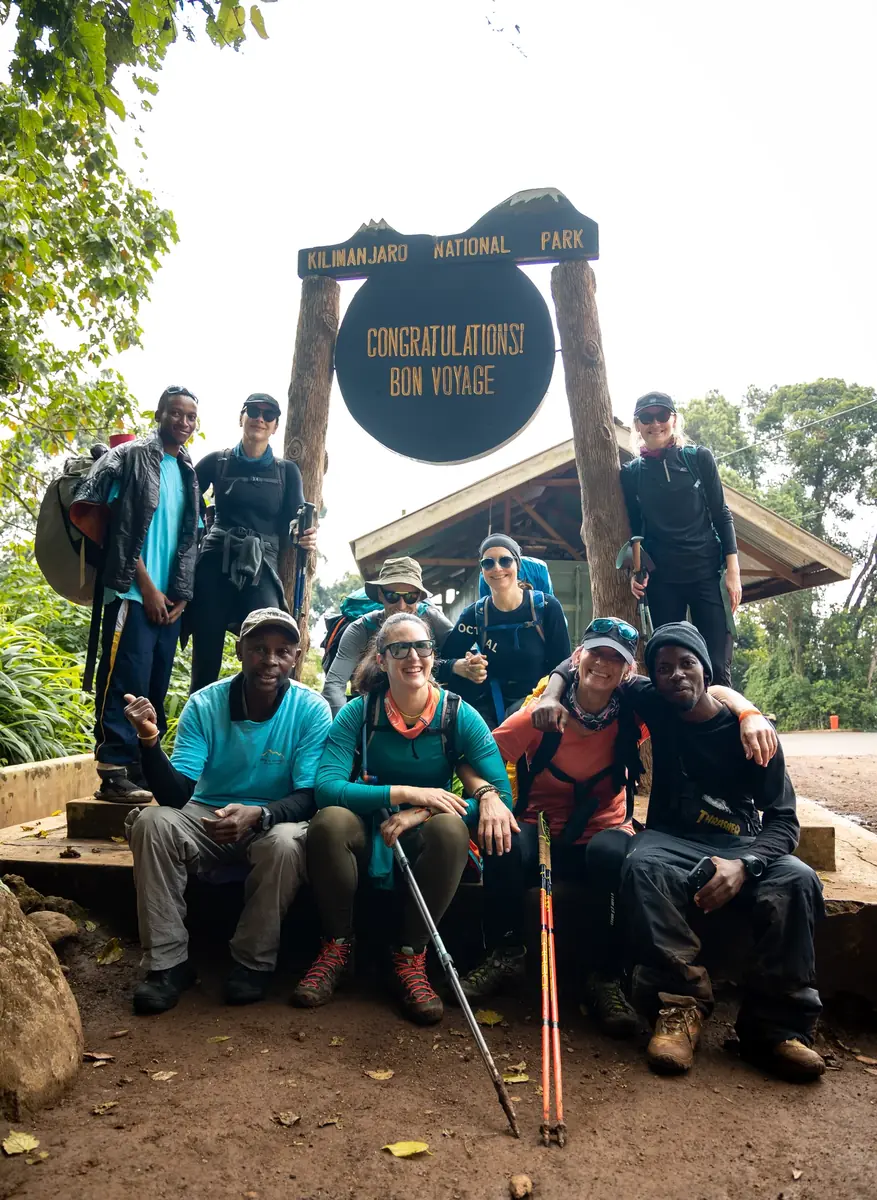
The Crater Rim at 5,895m
The summit of Kilimanjaro is defined by the crater rim of Kibo volcano, a caldera approximately 2.5km across. Within this crater sits the inner crater, home to the Furtwangler Glacier — the last significant remnant of the ice cap that once covered the entire summit. The glaciers you see from the summit are remnants of a once vast ice field that extended hundreds of meters further down the slopes as recently as the early 20th century.
From Uhuru Peak, on a clear morning, you can see: the curvature of the Earth's horizon to the east, the Kenya highlands to the north and east, the plains of Tanzania stretching south toward the Serengeti, and on the clearest days, Mount Meru rising to the west. You are standing at the highest point of an entire continent.
The Furtwangler Glacier
Named after the German geologist Walter Furtwangler, this glacier sits just below the summit inside the inner crater. It is the most iconic remaining ice feature on Kilimanjaro and has retreated significantly over the past century — estimates suggest the ice volume has decreased by approximately 75% since 1900. It is expected to disappear entirely within the next few decades.
The Summit Snowfield
The broad snowfield at Uhuru Peak covers approximately 400 meters along the crater rim. In wet seasons, this expands; in dry seasons, it contracts. The snow is firm in early morning (making the final ascent easier) and softens significantly after sunrise. This is why summit departures are timed for before dawn — the snow provides traction, and the firm surface makes the descent safer.
The Crater Rim Trail
From Stella Point (5,739m) to Uhuru Peak, the trail follows the crater rim for approximately 45 minutes. The path is relatively gentle — not a steep climb — but the altitude makes every step feel heavy. The wind on this section is the most intense you will experience on the mountain, with gusts capable of knocking unsteady climbers off balance.
Stella Point vs Uhuru Peak
Stella Point (5,739m) is often confused with the summit but is technically the false summit — the point where the crater rim trail meets the final ascent path from the crater floor. Climbers who turn back at Stella Point have not reached Uhuru Peak. The additional 45 minutes of effort between Stella Point and Uhuru Peak separates those who reached the true summit from those who stopped short of it.
What You Experience at Uhuru Peak
No account of Uhuru Peak captures it fully. The altitude removes the usual filters — you are simultaneously exhausted, euphoric, cold, and more present than you have ever been. Here is an honest description of what the experience actually feels like.

The Arrival (6am-8am)
Physical reality: You are breathing at approximately 12-14 breaths per minute — double your normal rate at sea level. Your legs feel like lead. Every step upward on the snowfield requires conscious mental effort to instruct your muscles to keep moving.
Emotional reality: Most people arrive silent. Not disappointed silence — the kind that comes when language feels inadequate for the moment. Your guide may be the first to speak, or may say nothing at all.
The Summit Sign
Physical reality: The sign is smaller than you expect. It is a metal marker bolted to a rock cairn at the high point. There is usually a short queue if other groups have arrived around the same time — a reminder that the summit is a shared space, not a private moment.
Emotional reality: There is a particular quality to the moment of standing at a sign that says 'you are at the highest point of Africa.' It takes a few seconds for the intellectual knowledge to sync with the felt experience.
The Views
Physical reality: The wind is constant and cold (-20C to -30C with wind chill). You cannot stay still for long without starting to shiver. You need to keep moving — pacing, bouncing slightly on your toes — to generate enough metabolic heat to stay functional.
Emotional reality: The view is not beautiful in a conventional landscape-photography sense. It is overwhelming in scale. You are looking down at cloud layer, at the curvature of the horizon, at glaciers that have existed for thousands of years. Your frame of reference for landscape stops working.
The Time Limit
Physical reality: You have approximately 30-45 minutes at the summit before guides will begin the firm encouragement to descend. This is not arbitrary — the body begins to deteriorate measurably at this altitude after extended exposure, even in experienced mountaineers.
Emotional reality: Thirty minutes sounds like a lot until you are counting every second because your fingers are too cold to operate your camera reliably. The urgency to capture the experience and the physical discomfort of staying create a strange tension.
What Climbers Say After Summiting
The summit is the moment every step on the mountain builds toward. Here is how climbers from our last season describe reaching Uhuru Peak with Mount Kilimanjaro Climb.
"I cried at Uhuru Peak. Not from cold, not from exhaustion. From the fact that I actually did it. First time I'd ever climbed anything serious. Philemon made me believe I could before I did."
"Mussa was incredible. Patient, knowledgeable, genuinely invested in my summit. They check your oxygen levels twice a day — I felt completely safe the entire time. Summit night felt achievable, not terrifying."
"Turned 60 on the mountain. Juma arranged a cake at Karanga Camp. Small thing, but it meant the world. He made the climb feel personal, not transactional. Then I stood at the roof of Africa."
"Ali explained exactly what to expect at altitude and helped me manage my fear of the summit. No panic, no drama. Just a professional team doing their job perfectly. Would climb again tomorrow."
Summit Day
What to Wear at 5,895m
Summit night on Kilimanjaro runs from approximately 11pm to 10am the next morning, crossing temperatures from +5C at camp to -25C at the peak. The layering system you carry — not your fitness, not your experience — is the variable that determines whether that window stays manageable.
The summit gear you need is different from trekking gear. Down suit vs synthetic layers. Balaclava vs neck gaiter. Glove liner vs mitt shell. We have a complete breakdown of what we provide, what to rent in Arusha, and what to bring from home.
Read the Summit Gear Guide →
The Summit Day Timeline
Summit day is the longest and most demanding day of any Kilimanjaro climb — typically 12-16 hours from wake-up to return to base camp. The exact timing varies by route, camp position, and weather conditions. Here is the sequence on the Machame route as a reference:

The Summit Certificate
Every climber who reaches Uhuru Peak receives an official summit certificate from Kilimanjaro National Park. This is not a marketing document — it is an official park certificate with your name, the route you climbed, the dates, and the elevation. It is issued at the park gate when you complete the climb, not at the summit.
What the Certificate Contains
- Your full name as registered with the park
- The route taken (e.g., Machame, Lemosho, Rongai)
- Number of days on the mountain
- Elevation reached: 5,895m
- Date of summiting
- Official Kilimanjaro National Park seal and signature
The certificate is proof of your summit for any future travel or mountaineering documentation. Some climbers laminate it; others frame it. Our guides have seen it carried in backpacks for years as a reminder of what was accomplished. It is one of the few tangible objects you will bring down from the summit — the other being photos and, in most cases, a significantly changed sense of what you are capable of.
Why the Glaciers Matter
The glaciers on Kilimanjaro are the most visible and emotionally striking features of the summit zone. They are also the most urgent reminder of what is changing. The ice cap on Kilimanjaro has retreated dramatically over the past century, and projections suggest the remaining glaciers — including the Furtwangler Glacier at the summit — will disappear within the next few decades.

75%+
Ice volume lost since 1900
1912
First photographic record of the ice cap
2030s-2050s
Projected full glacial loss
5,895m
Glaciers survive because of altitude cold
There is a particular weight to standing at the summit knowing that the glaciers you are photographing may not exist in their current form within your lifetime. Some of our climbers are scientists — glaciologists, climate researchers — who have come specifically to document the retreat. Others are first-time mountaineers who had not thought about climate change until they stood at the summit and looked at what is being lost. Reaching Uhuru Peak is not just a personal achievement. It is a visit to a place that is changing faster than almost anywhere else on Earth's surface.
How to Maximize Your Summit Success
Summit success on Kilimanjaro is not random. It follows patterns that are well understood by operators who have been running climbs for decades. The gap between a 60% summit success rate operator and a 95% rate operator is not luck — it is protocol, preparation, and honesty about which climbers can safely continue.
Choose the right route length
Routes of 7 days or fewer have significantly lower summit success rates because they do not allow sufficient acclimatization time. The Machame 7-day and Lemosho 8-day routes have the highest success rates because they follow the 'climb high, sleep low' principle — gaining altitude during the day and returning to lower elevations at night.
Train specifically for Kilimanjaro
Cardiovascular fitness matters, but Kilimanjaro-specific fitness matters more. Training should include: weighted hiking (8-10kg pack) for 6+ hours on uneven terrain, back-to-back hard days to simulate the cumulative fatigue of summit day, and practice hiking at very slow speeds (2-3km/h) for extended periods — this is the actual pace you will maintain on summit night.
Master the pole-pole principle
Pole-pole (Swahili for 'slowly slowly') is not a suggestion. It is the single most important behavioral factor in summit success. Climbers who maintain a hiking pace of 2km/h or slower consume their glycogen reserves at a rate that allows them to reach the summit. Climbers who push harder at 3-4km/h hit the wall before reaching Stella Point and turn back not because they are ill, but because they ran out of energy.
Manage cold and hydration simultaneously
At -20C, the instinct is to stop moving to conserve heat. The opposite is true — you must keep moving to generate metabolic heat, but you also must keep drinking to maintain blood volume and oxygen delivery. Our guides enforce hydration checkpoints every 45 minutes on summit night regardless of whether climbers feel thirsty.
Be honest about how you feel
The most common reason for summit failure is not physical inability — it is summit fever: the psychological refusal to acknowledge altitude illness symptoms because the summit is so close. Our guides are trained to make the turn-back call at Stella Point if a climber's SpO2 drops below 65% or if they show signs of confusion or ataxia. Turning back is not failure. It is the difference between a bad day and a medical emergency.
What Happens After the Summit
The descent from Uhuru Peak is technically easier than the ascent — gravity is now working in your favor — but it presents its own serious challenges that are often underestimated. Most of the serious injuries on Kilimanjaro happen on the descent, not the ascent.
The Scree Descent
Coming down the Lava Tower scree section on your knees is 3-4x more damaging to your joints than hiking downhill at sea level. The impact travels through your knee joints with each step. Trekking poles are not optional on this descent — they transfer load from your knees to your arms and core.
The Heat Reflection
The sun reflecting off the snow at altitude burns faster than direct sun at sea level. This is especially true on the descent when you are tired and less aware of reapplying sunscreen. The backs of your hands, your nose, and your lips are particularly vulnerable.
Post-Summit Depression
It is not uncommon to feel a strange sadness after the summit — a sense of anticlimax or flatness in the days following the climb. This is partly chemical (your body has been operating at extreme altitude and is recalibrating), partly the sudden absence of a clear goal. It passes within a few days.
The Descent to Moshi
Most climbers descend from the mountain to Moshi town in the Arusha region, where hot showers, cold beers, and beds that are not tents await. The drive from the park gate to Moshi takes approximately 90 minutes. Altitude acclimatization continues for 24-48 hours after leaving the mountain — avoid alcohol and strenuous exercise during this window.
The Alternative: Adding a Safari After Uhuru Peak
Standing at the roof of Africa is the climax of a Kilimanjaro climb — but it is not the only highlight of a Tanzania trip. The combination of a Kilimanjaro summit and a Tanzania safari is the most common extension our clients request, for good reason: having pushed your body to its limits at altitude, descending into the Serengeti or Ngorongoro Crater offers a completely different kind of wildlife experience that feels like a different kind of reward after the mountain.
Why Climb + Safari Works Physically
The minimum recommended rest between Kilimanjaro summit and safari departure is 24 hours. This allows your body to begin recalibrating to lower altitude oxygen levels. By the time you enter the Serengeti (1,400m-1,800m), you will be breathing normally again — and the relative ease of wildlife viewing after the physical demands of the mountain creates a psychological reward that many of our clients describe as the best few days of their lives.
We coordinate climb-and-safari itineraries for this exact reason: a private 7-day Machame climb followed by a 4-day safari through the Serengeti and Ngorongoro, with one night in Moshi between the two for recovery, is a combination that has produced more 'life-changing trip' reviews from our clients than any other itinerary we offer.
If you are planning a Tanzania trip that includes both a Kilimanjaro climb and a safari, start with the climb — summiting first and then descending to wildlife is the sequence our guides and safari partners recommend. Climbing after a safari risks fatigue affecting your summit attempt; climbing first and then descending to safari means you arrive at the mountain in the best possible condition.
Ready to Stand at the Roof of Africa?
Reaching Uhuru Peak is not a question of mountaineering skill — it is a question of preparation, patience, and the right operator. Our guides have summited hundreds of times and know exactly how to manage every variable of summit day. Talk to Don about planning your climb.
Read our summit night explainer or 2026 success rate data.