Culture & Community
Chagga Culture at Base: What the Mountain Teaches Before You Climb
Most Kili content starts at the gate. But the mountain's real teachers are the people who've lived on its slopes for 500+ years.

Who Are the Chagga People?
The Chagga people number approximately 1.5 million on Kilimanjaro's southern and eastern slopes — a Bantu-speaking farming community whose relationship with the mountain dates back more than five centuries. They are not newcomers to these heights. They are the mountain's original inhabitants.
Their engineering is remarkable. The maua ya Chagga — the Chagga irrigation system — is a network of hand-carved stone channels, some dating to the 16th century, that direct snowmelt from Kilimanjaro's peaks down through banana groves, coffee terraces, and maize fields. No pumps. No electricity. Pure gravity and craftsmanship passed through generations.
To the Chagga, Kilimanjaro is not merely a climbing objective. It is Kirua — a living deity, the source of all water, and the anchor of their cosmology. Chagga oral tradition explains the mountain's snow cap through a story of divine marriage between fire and water — a union that keeps the summit white and the fields below fed.
This is the worldview climbers arrive into when they spend a day in Moshi before their climb. It reframes the mountain entirely.

The Coffee Experience
Chagga coffee grows at 1,400–1,800 metres — the same altitude as some Kilimanjaro camps. Climbers who take the pre-climb village visit walk through these terraces, hand-pick red coffee cherries, and watch the traditional roast. The experience is not staged for tourists. It is how Chagga families have lived for generations.
The traditional roast is specific: cloves, banana, and ng'azi (coconut spirit) added during the roasting process. The result is a coffee unlike anything in a high-street chain — rich, spiced, and deeply social. The coffee ceremony is not about the drink. It is about community. To visit a Chagga home is to sit with the family elder, accept what is offered, and give the ceremony the time it deserves.
At Mount Kilimanjaro Climb, we offer this as a pre-climb add-on for every route. Most climbers who do it say it is the part of their trip they remember most clearly — not the summit, but the morning in the terraces, the smell of roasting coffee, the conversation with a Chagga family elder.
Add a Chagga cultural day to your climb — village walk, waterfall, coffee ceremony, and traditional lunch. Available as an add-on when you book via WhatsApp.
Chagga Proverbs as Mountain Wisdom
Chagga oral tradition is dense with practical wisdom. One proverb that resonates particularly with altitude climbing: “Mti hulima kwa shingo yake” — a tree stands by its trunk. The community is the trunk. The individual is nothing without it.
On the mountain, this translates directly. Local Chagga guides have materially lower accident rates than guides imported from elsewhere — because they read the mountain through a relationship built over years, not weeks. They know which ridge channels cold air, which camp sits in a wind shadow, which section of the Barranco Wall shifts after rain. This knowledge is not in a manual. It is inherited.
The concept of utani — the debt of kindness — structures how Chagga guides treat climbers. The guide carries the climber. The climber owes the guide respect and follow-through. This is not a transaction. It is a relationship with obligations on both sides. Climbers who understand this often perform better at altitude — they trust the guide more completely, and that trust reduces panic on summit night.
Then there is pole pole. The Swahili word is universal on Kili, but its spirit is Chagga — slow is fast. The guides drill this from day one. Climbers who internalise it summit. Climbers who fight it turn back.
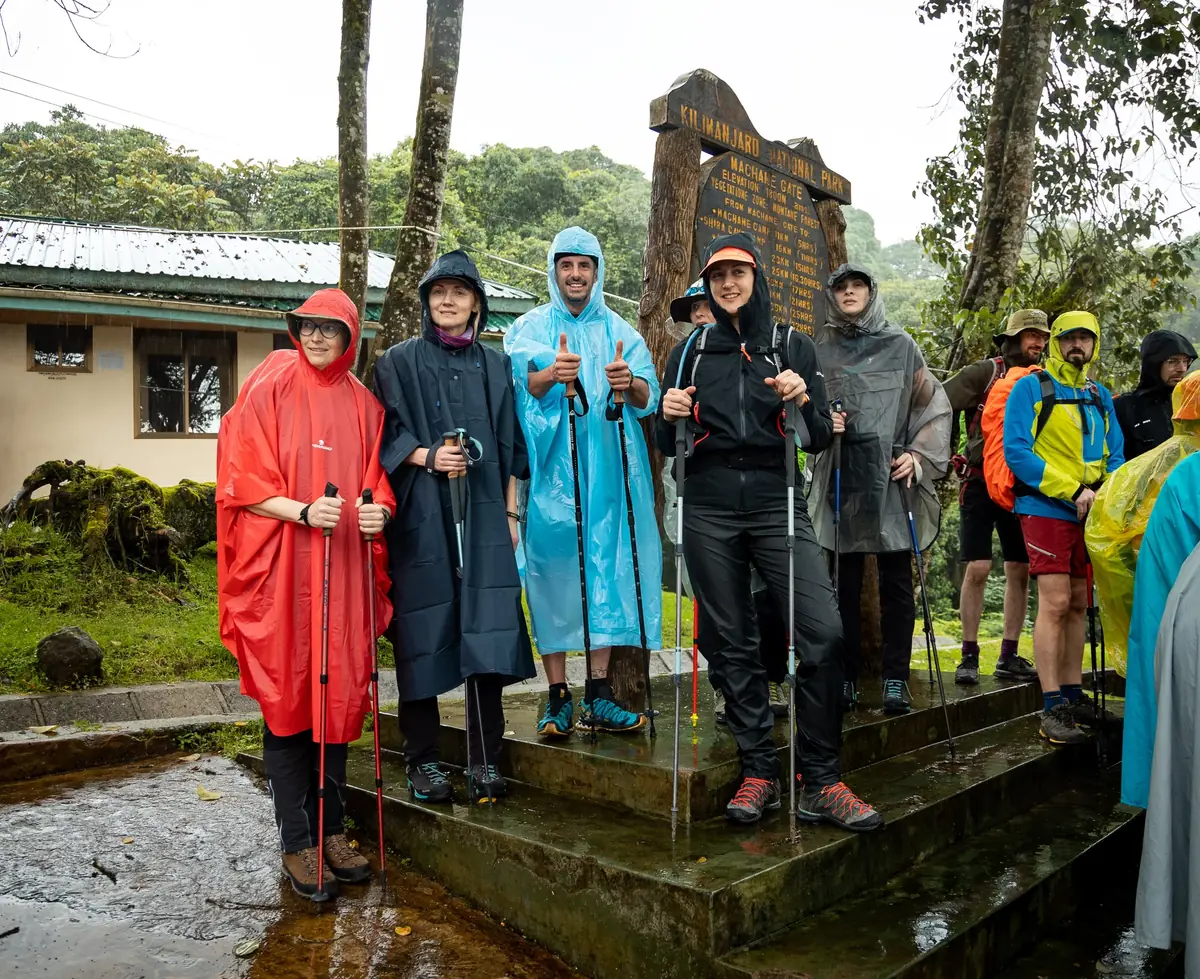
The Lower Slopes — Where Climbers Are Greeted by Generations
Every Chagga family on Kilimanjaro's lower slopes has a climbing ancestor. The mountain has been an economic and spiritual lifeline for five centuries — and the families who live there have been guiding on it for just as long. This is not an industry. It is inheritance.
On Machame route, day one passes through actively farmed Chagga land before the national park gate. Coffee terraces line the path. Banana groves shade the trail. Children wave from doorways. This is not a buffer zone between the real climb and civilisation. It is part of the climb — the part most operators rush through so climbers can “start” their Kili experience.
The national park fee is worth understanding in this context. A portion funds Chagga school bursaries, clinic access, and water projects for the communities who have lived on the mountain's flanks for centuries. When climbers pay the park fee, they are not just buying a climbing permit. They are contributing to a community that has been the mountain's keeper for five hundred years.
The pre-climb cultural day in Moshi — Marangu village walk, a waterfall visit, the coffee ceremony, and a traditional lunch — is designed to give climbers this context before they reach the gate. By the time they start ascending, they are not strangers to the mountain. They have already been its guests.
What the National Park Fee Supports
- →Chagga school bursaries — local children attend secondary school on park-funded scholarships
- →Clinic access — healthcare facilities serving 30+ villages on the mountain's slopes
- →Water projects — maintenance of the hand-carved irrigation channels that sustain Chagga terraces
- →Search and rescue — park-funded teams trained for high-altitude emergency response
Arrive Before You Ascend
Most climbers rush to the gate. Those who spend a day with the Chagga people return transformed — not just because they summited, but because they understand what the mountain means to the people who have called it home for five hundred years. The climb becomes richer when the mountain is a person, not just a peak.
Add a Chagga cultural day in Moshi to your climb. Village walk, waterfall, coffee ceremony, traditional lunch. It takes one day before your climb starts — and it changes everything about how you walk up the mountain.
WhatsApp Don — Add a Cultural Day