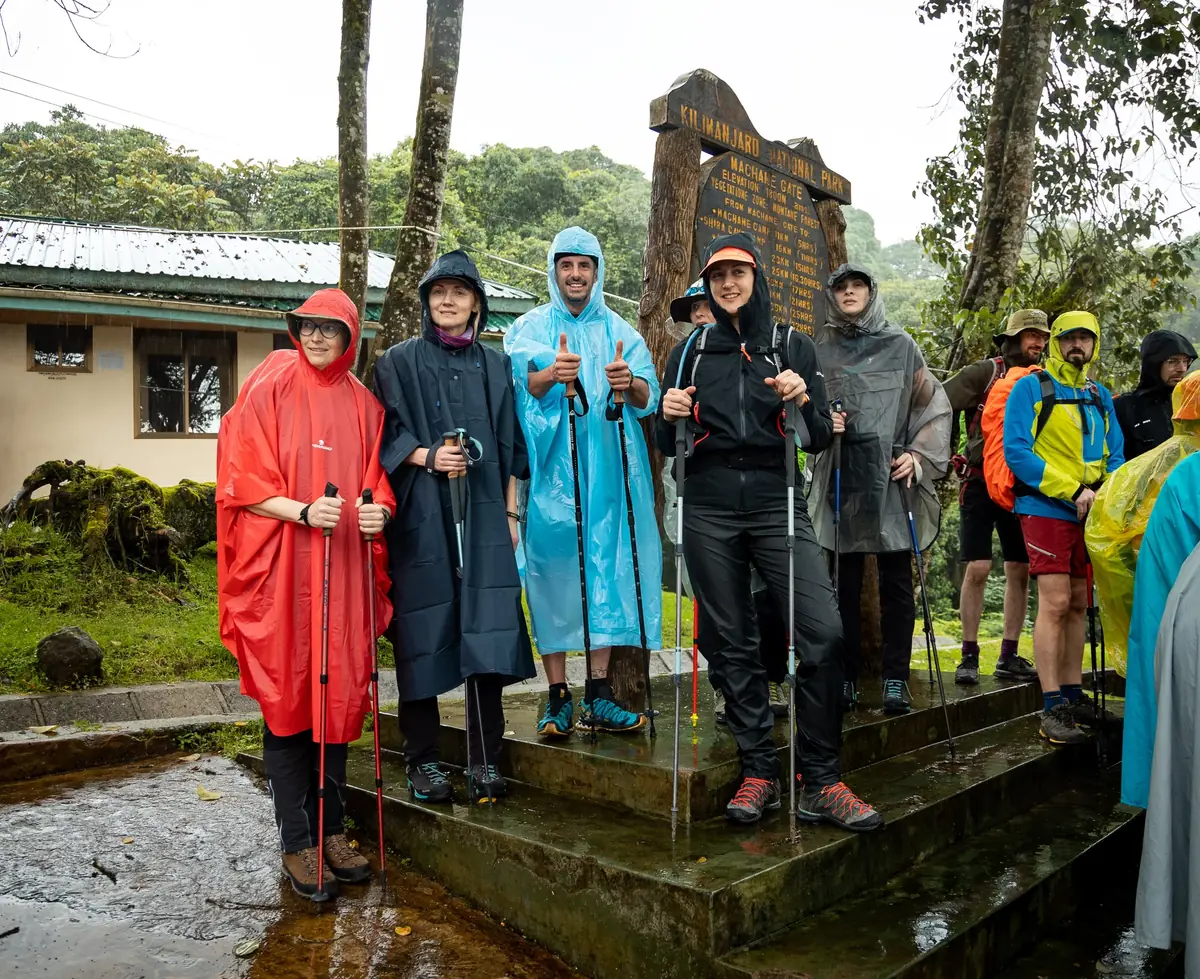
Your Body on Kilimanjaro: Day-by-Day From Gate to Summit
Every day on Kilimanjaro tells your body a different story. This is what it actually feels like — from the first step at the gate to the descent after the summit.
The mountain tells your body a new story every day. Most content focuses on elevation profiles, success rates, and gear lists. This is about something different: what you will actually feel, hour by hour, from Moshi to the summit. Understanding what is coming does not make Kilimanjaro easier — but it makes the hard days less surprising, and that matters more than most climbers realise.
The timeline below follows a standard 7-day Machame Route ascent. Your experience may vary slightly by route and season, but the body's arc is consistent across all paths up Kili.
Day 1: Moshi to Gate — The Sea-Level Goodbye
You step off the transfer from Moshi into warm, thick air. The humidity is immediate — it presses against your skin like a wet cloth. Your shirt is damp within ten minutes. This is not altitude. At 1,800m your blood oxygen saturation is still approximately 95%, nearly identical to sea level. Whatever you feel today is terrain and temperature, not thin air.
The pack and the trail
Your daypack feels heavy at first — water bottles, layers, camera. After an hour of steep, root-crossed trail you understand why the briefing mentioned pack weight. The rainforest section of the Machame Route is deceptively physical: no altitude excuse, just steep terrain and tropical humidity. New boots that have not been broken in will announce themselves by midday as hot spots on your heels and toes. Foot care starts on Day 1.
Appetite at sea level
Your GI tract is still completely normal. Dinner at Machame Camp will be the most normal meal you eat on the mountain. Enjoy it. Calories consumed on Day 1 go toward glycogen stores that will carry you through the week. Eat well tonight — it is the last meal that will feel straightforward for a while.
Day 1 Key Numbers
- Altitude: 900m to 1,800m
- SpO2: ~95%
- Walking time: 5–7 hours
- Temperature: 20°C–28°C
- Challenge: humidity, steep terrain, new boots
Day 2: Rainforest to Shira — First Whispers
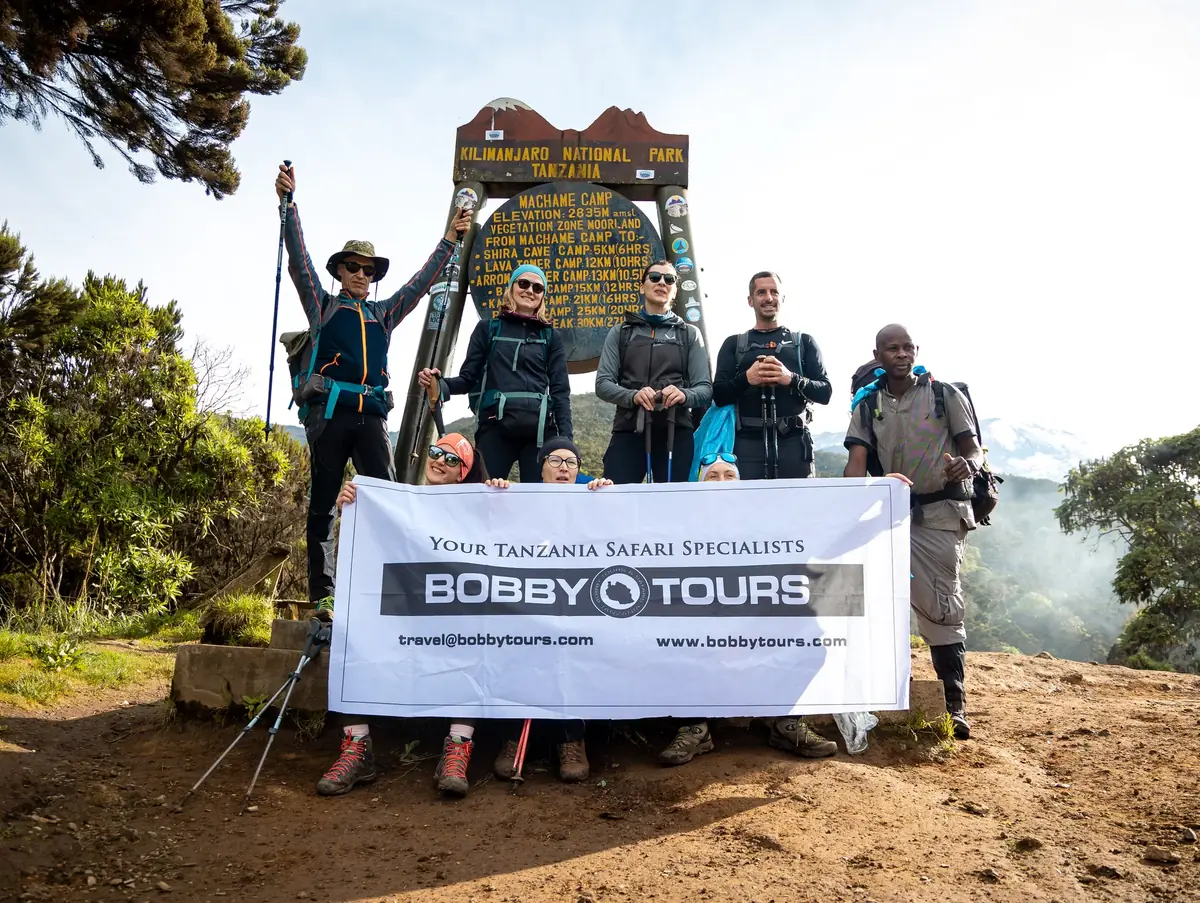
You wake at Machame Camp (2,800m) and notice something without being able to name it immediately. Your first cup of coffee tastes the same. Your legs feel fine. But there is a faint presence in your breathing — a sense that each breath is doing slightly more work than it did yesterday. This is the first whisper of altitude.
The breathing change
At 2,800m your resting respiratory rate increases from roughly 14 breaths per minute to 16–18. You will not feel breathless at rest, exactly. It is more that breathing is now something you notice — present in a way it is not at sea level. At the second hill crest of the morning you are slightly more winded than you would expect. Not alarming. Just present.
The first headache
Some climbers get a very mild headache by late afternoon on Day 2. If it is a dull, mild ache without nausea or light sensitivity, this is a normal altitude adjustment — not yet acute mountain sickness. A single paracetamol, 500ml of water, and a rest period typically resolves it. This is the beginning of the body's compensation mechanism: producing more red blood cells to carry the reduced available oxygen.
Sleep disruption begins
The first fragmented night typically arrives around here. You will sleep, but lighter and with more waking. Your heart is working harder overnight — elevated heart rate persists at altitude even during sleep. This is not a sign you are failing to acclimatise. This is the adaptation process.
Day 2 Key Numbers
- Altitude: 2,800m to 3,000m
- SpO2: ~90–92%
- Resting pulse: +10–15 bpm above normal
- Walking time: 4–6 hours
- Temperature: 5°C–25°C
Day 3: Shira to Barranco — The Crossing
Day 3 is the transition day, and it announces itself in the quality of the air. By the time you reach Barranco Camp (3,900m) you are breathing at altitude whether you want to or not. The panoramic views from the Barranco Wall are genuinely extraordinary. Your body, at this moment, does not care. You are tired in a way that is specific and new.
Deeper breathing, at rest
At 3,900m your SpO2 is approximately 85–90%. You will notice this most when you stop moving. On the flat, you are breathing noticeably deeper than normal. Climbing the Barranco Wall itself — which is steep but short — will have you counting breaths afterward. This is not yet emergency territory. This is the body doing what it evolved to do.
Mood can swing
Altitude affects neurotransmitter regulation. By Day 3 many climbers notice emotional volatility — irritability, homesickness, sudden unexplained low mood, or conversely, bursts of euphoria. These are documented physiological effects, not personal weakness. They are most intense in the afternoon when fatigue compounds altitude stress. Warn your group. Be patient with each other.
Appetite suppression intensifies
Food is now a chore. The body's way of reducing metabolic load at altitude is to suppress hunger signals. You are not less hungry because you are exerting less — you are less hungry because altitude is changing your appetite chemistry. Eating is still critical. Force yourself. Every calorie you consume now is used efficiently by the body at altitude. The pasta at Barranco Camp may taste like cardboard. Eat it anyway.

Day 3 Key Numbers
- Altitude: 3,000m to 3,900m
- SpO2: ~85–90%
- Mood effects: documented, altitude-related
- Appetite: significantly reduced
- Walking time: 5–7 hours
Day 4: Barranco to Karanga — Building Resilience
The morning at Barranco Camp starts with a view and a headache that may or may not be there. By Day 4 your body has made initial altitude adjustments — you are not worse than Day 3, but you are also not better. You are simply adapted to being uncomfortable, which is itself a form of progress.
The mental low point
Day 4 is statistically the day most people come closest to quitting in their heads. The excitement of Day 1 has worn off. The summit is still two days away. Your legs ache, your appetite is gone, and the altitude has your head in a mild vice. This is the psychological crux of Kilimanjaro — and it is physiological in origin. Dopamine and serotonin regulation is measurably disrupted at 4,200m. The "why did I do this" feeling is altitude, not character.
The climbers who reach the summit are not the ones who never feel this. They are the ones who keep walking anyway, lean on their guide, and trust the process. Pole pole — slowly — is not a slogan. It is the only pace that works at this altitude.
Core temperature management
At 4,200m your body's thermal regulation is noticeably harder. The gap between sunny and shaded microclimates on the trail feels extreme — you are too warm in the sun, then shivering within sixty seconds of stopping in shade or wind. Layers must be managed actively throughout the day, not just morning and evening.

Day 4 Key Numbers
- Altitude: 3,900m to 4,200m
- SpO2: ~82–87%
- Mood: altitude-related emotional low (normal)
- Thermal regulation: actively challenging
- Walking time: 4–5 hours
Day 5: Karanga to Barafu — Base Camp State
At 4,600m the air contains roughly 40% less oxygen than at sea level. You will notice this within the first ten steps out of camp. Every step upward requires conscious effort in a way that previous days did not. Social conversation drops. The group walks in a focused, meditative line. This is the preparation day before summit night — and the body is already in pre-summit mode.
Hands and toes: the first cold risk
At Barafu Camp (4,600m) peripheral circulation is already compromised by altitude. Your hands and toes are the first indicators. On cold mornings, toes may feel numb even in thick socks. This is not yet frostnip — but it is the warning zone. Active warming strategies begin today: hand warmers in pockets, boots warmed by sleeping bag before putting them on, gloves layered and managed between shaded and sunny sections.
Breathing at rest
Resting respiratory rate at Barafu is typically 22–28 breaths per minute. If you count yours, it may surprise you. This is the body compensating for reduced oxygen availability by increasing ventilation. It is not distress — it is the system working as designed. You are breathing like someone who has just finished a fast run, except you are sitting still.
Sleep strategy
Summit night begins at midnight or earlier. Day 5 is about banking as much sleep as possible before the alarm goes off. Afternoon naps are not indulgent — they are preparation. Go to bed early. Do not read or scroll. Sleep is the most valuable commodity on the mountain right now.

Day 5 Key Numbers
- Altitude: 4,200m to 4,600m
- SpO2: ~75–82%
- Resting respiratory rate: 22–28 breaths/min
- Cold injury risk: hands and toes (warning zone)
- Walking time: 4–5 hours
Day 6: Summit Night — The Ultra
The wake-up call comes between 10pm and midnight. You have slept four or five hours. You are not fully rested — nobody is, at 4,600m. You put on every layer you own and the process takes fifteen minutes. You eat a few bites of food without really wanting to. You drink warm liquid from a thermos. Then you step outside into a cold that is unlike anything you have felt before.
The cold
-15C to -25C with wind chill is not the cold of a winter morning at home. It is a hard, dry cold that penetrates through jackets within minutes. Exposed skin develops frostnip in two to five minutes at these temperatures with wind. Your balaclava is up. Your goggles are on. The stars above Uhuru Peak are so bright they look artificial.
The first two hours
Your core body temperature drops approximately 1.5C in the first two hours of summit night. Peripheral vasoconstriction kicks in hard — blood is shunted away from hands and feet toward core organs. Your hands and toes begin to feel like they belong to someone else. Movement is warmth. You cannot afford to stop for more than sixty seconds. Stopping is not a tempo option — it is a thermal emergency.
The hypoxia
At 5,895m your SpO2 is approximately 50–60% — half the oxygen of sea level. At this saturation, measurable cognitive impairment is documented. Climbers describe it as a dreamlike state: thoughts feel slow, decisions feel heavy, time becomes elastic. Most describe the experience not as agony but as a long negotiation with discomfort. One hour at a time. One breath at a time. Pole pole.
The summit
When you reach Stella Point (5,739m) or Uhuru Peak (5,895m), adrenaline suppresses the worst symptoms temporarily. You feel euphoria, relief, and a strange floating lightness. You may cry. You may not. Both are normal. Then the descent begins — and within two hours of walking down, your legs will feel normal again. That contrast is the most shocking thing about summit morning: how quickly the body recovers when oxygen returns.

Summit Night Key Numbers
- Altitude: 4,600m to 5,895m
- SpO2: ~50–60%
- Core temp drop: ~1.5C in first 2 hours
- Wind chill: -15C to -25C
- Walking time: 7–9 hours to summit
- Recovery begins: within 2 hours of descent
Day 7: Mweka Descent — The Return
The descent from Mweka Camp (3,100m) to Mweka Gate (1,800m) is 2,800m of vertical drop in a single day. Your legs will feel normal again by mid-morning — the re-oxygenation effect is that fast. But the descent punishes you in a different way.
The quad and knee problem
Every step downhill loads your quadriceps and knees at 3–4 times body weight. After summit day, when your legs are already depleted, the Mweka descent is genuinely painful. Expect burning quads and sore knees. Hiking poles are not optional — they transfer significant load to your upper body and reduce knee strain substantially.
The recovery paradox
Many climbers feel remarkably good on the descent — better than they have felt in days. This is partly adrenaline, partly the rapid re-oxygenation. Do not mistake this for full recovery. The body is depleted in ways that take days to rebuild. Over the following 48 hours, as SpO2 returns toward normal, genuine fatigue will surface that sleep does not immediately fix.
Full recovery timeline
Most climbers feel back to baseline within 3–5 days of returning to Moshi (900m). Full physical recovery — the sense of being fully back to pre-climb condition — typically takes 7–14 days. Do not book anything strenuous for two weeks after the climb. Your body needs the time.

Recovery Key Numbers
- Return to baseline SpO2: 24–48 hours
- Energy normalization: 3–5 days
- Full physical recovery: 7–14 days
- Knee/quad soreness: 3–7 days
- Medical red flag: symptoms >48h post-descent
How to Support Your Body on Kilimanjaro
The body's performance on Kilimanjaro is not random. Preparation matters — and the good news is that the factors within your control make a meaningful difference to how you feel at altitude.
Train for altitude specifically
Cardiovascular fitness matters, but altitude tolerance is trained. Hike with a loaded pack at elevation where possible. If you live at sea level, consider a pre-acclimatisation protocol. See our training plan.
Eat even when you do not want to
Appetite suppression at altitude is a physiological signal, not a useful data point. Force calories in the morning and evening. The body uses them efficiently at altitude. See nutrition strategy.
Sleep is your most valuable asset
Every hour of sleep at altitude supports the adaptation process. Summit night is won or lost in the sleep you bank the two nights before. Protect it aggressively. Altitude and sleep guide.
Pole pole changes everything
The single most common climber mistake is walking too fast. Altitude compounds speed punishingly. Slow down to half your comfortable pace. The mountain does not care about your Day 1 fitness level — it only cares about your current physiology. Read the pole pole guide.
Know Your Body Before You Climb
Every climber is different. Don reviews each climber's health profile and fitness history before departure and adjusts pacing and rest stops accordingly. Ask him anything.