
The Descent Is Where Climbers Quit
A tactical guide to the Mweka Route down Kilimanjaro — and why the downhill is harder than the summit push.
By Mount Kilimanjaro Climb · 5 min read
You trained for the ascent. The descent is what will break you.
The summit night gets all the drama. The Mweka Route gets all the injuries. Kilimanjaro's primary descent path drops 4,255m in roughly 10km — and the terrain does not care that you just stood at the top of Africa. Most overuse injuries on the mountain happen below the summit. Most accidents happen on the way down. And the section most climbers underestimate is the Mweka.
Why descent is harder than it looks
Physiologically, downhill is more demanding than it appears. When you ascend, your muscles work concentrically — they shorten as they fire. When you descend, they work eccentrically: they lengthen under load as they resist gravity. Eccentric loading produces more muscle damage, more delayed-onset soreness, and requires more recovery time than equivalent uphill effort.
Your knees take the specific punishment. On steep downhill, the knee joint loads with roughly three times your body weight with every step. At altitude, where hypoxia impairs proprioception — your sense of where your joints are in space — that repeated impact lands on a body that cannot accurately sense its own position. This is why twisted ankles and knee strains are the most common descent injuries on Kilimanjaro.
Cognitive fatigue is the third factor nobody discusses. You summited at 5,895m. Your brain has been operating at altitude for days. Post-summit euphoria is real — and it hides the cognitive fog underneath it. On the Mweka descent, this shows up as overconfidence on technical terrain and a tendency to rush the sections that require the most care.
Mweka Route at a Glance
Total distance
10 km
Elevation loss
4,255m
Start / End
5,895m / 1,640m
Duration
6–9 hours
The Mweka profile: Barafu to Mweka Gate
The descent has two distinct sections with very different demands. The upper section — Uhuru Peak to Mweka Camp at 3,000m — covers roughly 6km through Kilimanjaro's alpine desert. The surface is loose volcanic scree on slopes reaching 35–40 degrees. Every step sinks into shifting rock. Your quadriceps fire continuously to control your descent. Duration: 3–4 hours.
The lower section — Mweka Camp to Mweka Gate at 1,640m — descends through montane rain forest. The trail narrows, roots cross at angles, mud appears year-round. In the wet seasons (April–May and November–December), the trail becomes a stream. Duration: 3–5 hours.
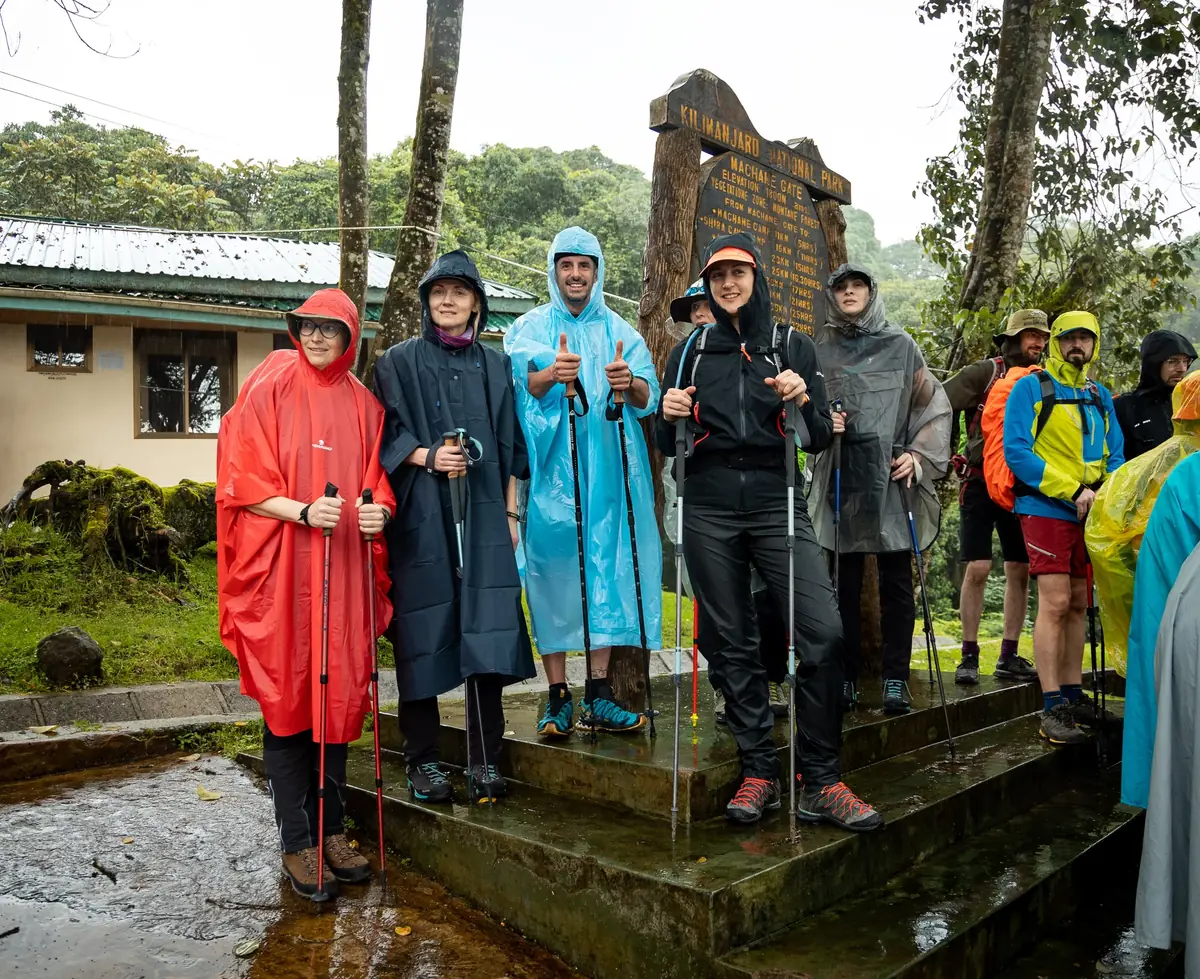
Pole pole on descent: the rule applies twice
Pole pole — Swahili for slow slow — is the central pacing discipline of Kilimanjaro ascent. On descent via Mweka, it applies with equal force and twice the importance.
On the scree section, trekking poles give you three points of contact instead of two. They reduce knee joint load by approximately 20–25% on steep terrain. They keep your footing on a surface where a single misstep can mean a fall of several metres. Two poles, adjusted to the correct length for the gradient, with proper strap discipline — not optional equipment on the Mweka descent, it is load-bearing safety gear.
In the forest section, poles help with mud and roots. They also help manage the cognitive fatigue: having something to focus on other than the trail reduces the risk of a misstep caused by mental blanks.
Gear that matters on the Mweka descent
- Trekking poles (two): Non-negotiable. Reduce knee load by ~25% on steep scree. Adjustable are better than fixed.
- Knee braces or compression sleeves: If you have any prior knee history, the Mweka will test it.
- Gaiters: Keep scree out of boots above, mud out below. Takes 2 minutes to put on.
- Waterproof jacket and trousers: The forest section is wet at any time of year. In wet season, the trail is a stream.
The waterfall section: where injuries happen on day 7
Below Mweka Camp, the trail crosses several stream crossings that become waterfall-volume during and after rain. The trail is cut into the hillside, often with a vertical drop to one side. Roots catch boots. This section — approximately the last 2 hours before Mweka Gate — is where slips, trips, and twisted ankles concentrate on the Mweka descent.
The countermeasure is simple: test every foothold before committing your weight. Gaiters keep boots secure. Waterproof layers keep you warm when crossings are unavoidable. When the trail is a stream, walk through it deliberately rather than jumping the waterline.
The post-summit mental letdown
There is a specific psychological moment on the Mweka descent that experienced guides recognise: it arrives roughly 2–3 hours after leaving the summit, once the adrenaline fades.
You feel the weight of what you have just done. The euphoria of standing at Uhuru Peak gives way to physical exhaustion, altitude fog, and the long trail still ahead. Climbers describe this as the lowest point of the entire climb — lower than any difficult day on the ascent. It is transient, it is normal, and it passes. Knowing it is coming is itself a preparation.
The Mweka descent rewards patience. The mountain released you from the summit. The mountain will release you from the trail. Pole pole.
Descent difficulty by exit route
| Route | Descent path | Duration | Descent difficulty |
|---|---|---|---|
| Machame | Mweka Route | 6–9 hrs | High — scree plus forest |
| Umbwe | Mweka Route (steeper) | 5–8 hrs | Very high — steepest scree |
| Lemosho | Mweka Route (joins at Shira) | 7–10 hrs | Moderate — longer but gentler |
| Northern Circuit | Rongai Route (reverse) | 8–11 hrs | Moderate — gradual slope |
| Marangu | Same path both ways | 9–12 hrs | Low — built-in steps and rails |
Frequently Asked Questions
Why is the Kilimanjaro descent harder than the ascent?
Downhill places eccentric load on the quadriceps — muscles lengthen under load to control descent — which produces more muscle damage and delayed-onset soreness than concentric ascent effort. Your knees load with roughly three times your body weight on each step. At altitude, where hypoxia impairs proprioception, that repeated impact lands on a body that cannot accurately sense its own joint position.
Are trekking poles necessary for the Mweka descent?
Yes. Trekking poles reduce peak knee joint load by approximately 20–25% on steep downhill terrain. On the Mweka scree section, poles also provide three points of contact on unstable ground. Two poles, adjusted for gradient, with correct strap discipline — not optional.
What is the most dangerous section of the Mweka Route?
The waterfall section below Mweka Camp — approximately the last 2 hours before Mweka Gate — is where injuries concentrate. The trail is cut into the hillside, narrow, with exposed roots and stream crossings that become waterfall-volume in wet seasons.
Compare All Six Kilimanjaro Routes
Route comparison includes descent difficulty ratings, elevation profiles, success rates, and full pricing. Every data point you need to choose your route with confidence.
Kilimanjaro Climb — Ready to summit?
+255 786 110 786